 Image 1 of 1
.3mf files: Bb soprano tarogato
Please note: You are buying the .3mf files necessary to construct the JDWoodwinds Bb soprano tarogato. This project is intended for people with moderate experience in both 3D printing and clarinet/saxophone repair. These files are for personal use only and are not for commercial use, they cannot be transferred or sold.
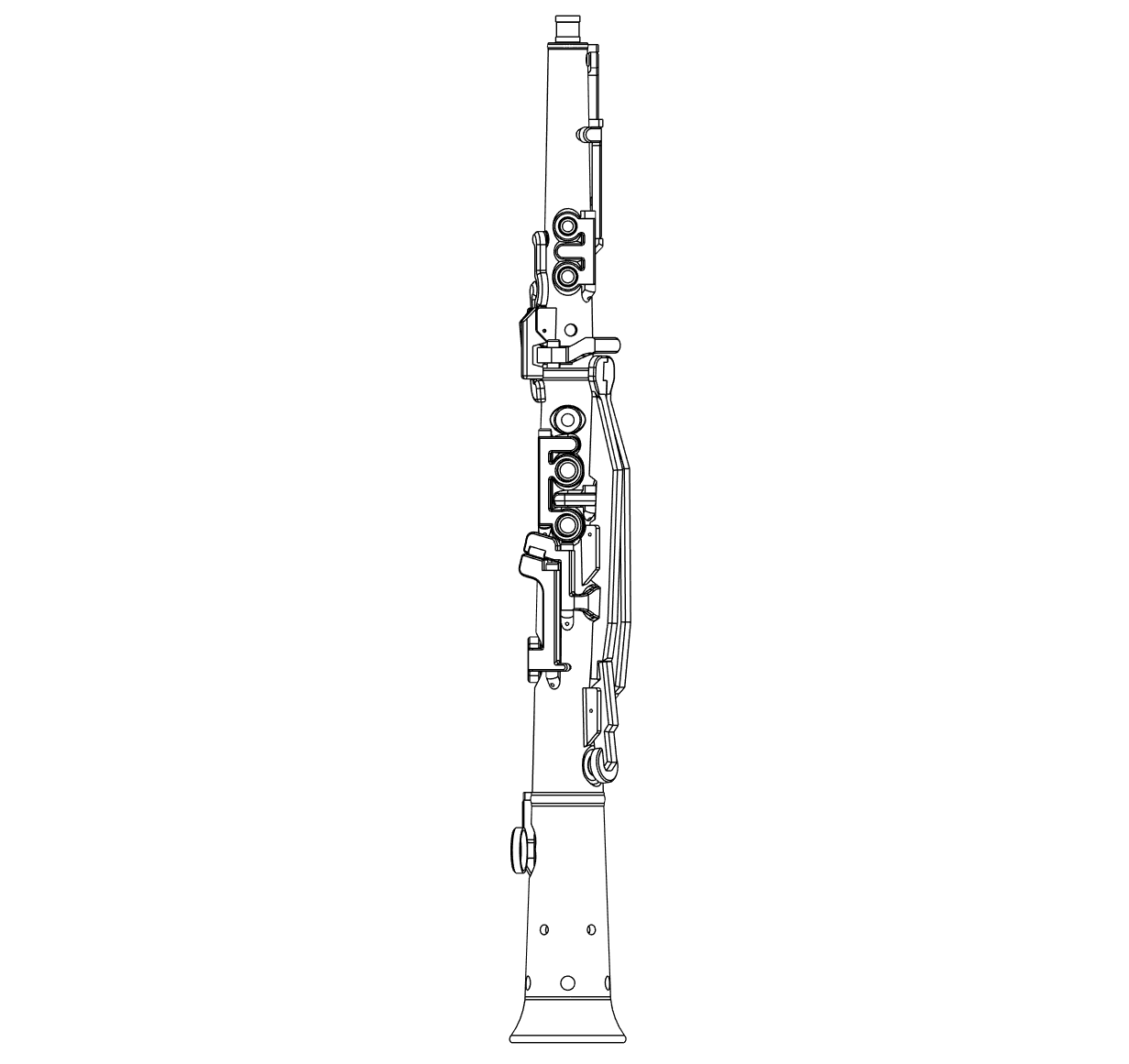
The JDWoodwinds Bb soprano tarogato is designed to pay homage to the instrument designed by János Stowasser over 130 years ago but with a modern twist. To design this instrument I first started by taking bore and tone hole measurements from an original Stowasser tarogato. I then designed my own set of key work and optimized the design to make it more suitable for 3D printing. Much like the most popular Stowasser model, this instrument has 4 rings, two octave keys and a range to low Bb. Unlike most Stowassers however the upper octave key is independent, allowing you to close the lower octave key when needed to make the highest notes more in tune. There is also a roller for each set of pinky keys, making sliding between notes easier.
These files do not include a mouthpiece. A mouthpiece and ligature can be purchased here. Otherwise it is designed to take a Stowasser sized mouthpiece.
Print settings:
A build volume of at least 170mm x 170mm x 300mm is recommended as the lower joint is just under 300mm long. .3mf files for the upper and lower joints that are split are also included, bringing the maximum height required down to 220mm.
I recommend printing all parts in ABS, ASA or PLA+ if temperature resistance is not a concern. For body joints I recommend at least 5 walls when using a 0.4mm nozzle. For the keys I recommend at least 15 walls to ensure the correct stiffness. The support threshold angle can be set under 5 degrees. All supported areas are designed to be horizontal, so if you find yourself needing supports on an angled surface you likely need to re-orient the part. The body joints and bell are designed to be printed standing upright. Make sure that your flow ratio is close to 1 to ensure a good airtight seal. For certain printers you may also need to seal overhangs with cyanoacrylate. For post processing you will need to remove supports and flatten the overhangs with a file. The tone holes will also need to be leveled with a tone hole tool. You can make one by modeling a simple cylinder that’s a few mm larger than the tone hole and gluing on 400 grit sandpaper.
Below is a list of non-3D printed components you will need to complete the project, you may need additional materials beyond this list as well:
3/64” cork sheet, only a small 9.75mm strip for the upper tenon is needed.
1/32” cork sheet, These are used for the two lower tenons and most key corks, I recommend one 4”x6” sheet
Music Medic Neo pads:
26mm x 2 (low C key and low Bb bell key)
20mm x 1 (Low B key)
1/16” Neoprene foam sheet (for remaining pads)
10mm hole punch (for all upper joint pads and lower ring key pad)
16mm hole punch (for F key pad and thumb rest cushion if desired)
20mm hole punch (for Eb key pad)
4mm neoprene cord (for key bumpers, must be 4mm)
Razor blades
2mm stainless steel rod (a few 300mm pieces should be more than enough, I would get a 10 pack as it is useful for other projects)
Contact cement
Rubberized cyanoacrylate (for Neo pads)
Long 2mm drill bit
Brass jawed pliers
Stainless steel coil springs:
15mm long x 4mm OD x 0.3mm wire diameter x 7
For octave keys, G# key, F key, low C key, low B key and low Bb bell key
10mm long x 4mm OD x 0.3mm wire diameter x 3
For ring keys and low Bb thumb lever
15mm long x 4mm OD x 0.35mm wire diameter x 4
Side keys, Eb key and low C# key
For printers under 300mm:
2 part epoxy for gluing joints together
2mm x 38mm long metal or carbon fiber rods to connect joint sections x 8
Long clamp for gluing joint sections together
Use the included bumper cutter file to cut the 4mm neoprene cord into 5mm long sections. These are then press fit into the 4mm holes found on both joints, no glue is needed or recommended. The octave keys and side keys will need key corks made from the 1/32” cork and the low B and low Bb keys need key bumpers made from the 3/64” cork sheet. These key corks should be installed with contact cement. The smaller keys use pads made from the neoprene foam. Use the hole cutters to cut out the pads. The thumb rest can also be cushioned with a 16mm foam disc with about 1mm from one side cut off with a razor blade. The Neo pads should be installed with the cyanoacrylate per Music Medic’s instructions. Level all tone holes before installing pads. Tenon corks can be installed like you would on a clarinet.
Keys should first be cleaned out with the long 2mm drill bit. From here take a 2mm rod and grind one end flat. Then this can be chucked and used as a broach to remove material from the key. Do this until the key moves freely on the 2mm rod but don’t overdo it or the key will be too loose. Note that you should straighten all rods on a bench motor or lathe before use. For hinge keys I recommend lightly flattening each end so they move freely. Clean out all of the posts with the 2mm drill bit but do not use the broach as the friction is what holds the rods in. Once you do this, dry fit all the keys. Ideally the keys should move freely with minimal slop. If the keys are too tight you can remove material from the posts until the key fits properly. To make the hinge rods cut the stainless steel rods to the following sizes:
Upper octave key: 107mm
Lower octave key: 88mm
Upper ring key: 59mm
Side keys: 26mm
G# key: 20mm
Lower ring key: 70mm
F key: 24mm
Eb key: 55mm
Low C key: 83mm
Left pinky levers: 31mm
Low B key: 20mm
Low Bb thumb lever: 20mm
Low Bb bell key: 55mm
Rollers: 20mm x 2
Chamfer and de-burr the edges of the rod. Use the brass jawed pliers to install them. The roller file needs to be printed twice and is installed onto the low C and low B lever keys in a similar manner to the other keys. Please note however that once they are installed they cannot be removed, so make sure they fit in the keys and spin freely before installing!
Please note: You are buying the .3mf files necessary to construct the JDWoodwinds Bb soprano tarogato. This project is intended for people with moderate experience in both 3D printing and clarinet/saxophone repair. These files are for personal use only and are not for commercial use, they cannot be transferred or sold.
The JDWoodwinds Bb soprano tarogato is designed to pay homage to the instrument designed by János Stowasser over 130 years ago but with a modern twist. To design this instrument I first started by taking bore and tone hole measurements from an original Stowasser tarogato. I then designed my own set of key work and optimized the design to make it more suitable for 3D printing. Much like the most popular Stowasser model, this instrument has 4 rings, two octave keys and a range to low Bb. Unlike most Stowassers however the upper octave key is independent, allowing you to close the lower octave key when needed to make the highest notes more in tune. There is also a roller for each set of pinky keys, making sliding between notes easier.
These files do not include a mouthpiece. A mouthpiece and ligature can be purchased here. Otherwise it is designed to take a Stowasser sized mouthpiece.
Print settings:
A build volume of at least 170mm x 170mm x 300mm is recommended as the lower joint is just under 300mm long. .3mf files for the upper and lower joints that are split are also included, bringing the maximum height required down to 220mm.
I recommend printing all parts in ABS, ASA or PLA+ if temperature resistance is not a concern. For body joints I recommend at least 5 walls when using a 0.4mm nozzle. For the keys I recommend at least 15 walls to ensure the correct stiffness. The support threshold angle can be set under 5 degrees. All supported areas are designed to be horizontal, so if you find yourself needing supports on an angled surface you likely need to re-orient the part. The body joints and bell are designed to be printed standing upright. Make sure that your flow ratio is close to 1 to ensure a good airtight seal. For certain printers you may also need to seal overhangs with cyanoacrylate. For post processing you will need to remove supports and flatten the overhangs with a file. The tone holes will also need to be leveled with a tone hole tool. You can make one by modeling a simple cylinder that’s a few mm larger than the tone hole and gluing on 400 grit sandpaper.
Below is a list of non-3D printed components you will need to complete the project, you may need additional materials beyond this list as well:
3/64” cork sheet, only a small 9.75mm strip for the upper tenon is needed.
1/32” cork sheet, These are used for the two lower tenons and most key corks, I recommend one 4”x6” sheet
Music Medic Neo pads:
26mm x 2 (low C key and low Bb bell key)
20mm x 1 (Low B key)
1/16” Neoprene foam sheet (for remaining pads)
10mm hole punch (for all upper joint pads and lower ring key pad)
16mm hole punch (for F key pad and thumb rest cushion if desired)
20mm hole punch (for Eb key pad)
4mm neoprene cord (for key bumpers, must be 4mm)
Razor blades
2mm stainless steel rod (a few 300mm pieces should be more than enough, I would get a 10 pack as it is useful for other projects)
Contact cement
Rubberized cyanoacrylate (for Neo pads)
Long 2mm drill bit
Brass jawed pliers
Stainless steel coil springs:
15mm long x 4mm OD x 0.3mm wire diameter x 7
For octave keys, G# key, F key, low C key, low B key and low Bb bell key
10mm long x 4mm OD x 0.3mm wire diameter x 3
For ring keys and low Bb thumb lever
15mm long x 4mm OD x 0.35mm wire diameter x 4
Side keys, Eb key and low C# key
For printers under 300mm:
2 part epoxy for gluing joints together
2mm x 38mm long metal or carbon fiber rods to connect joint sections x 8
Long clamp for gluing joint sections together
Use the included bumper cutter file to cut the 4mm neoprene cord into 5mm long sections. These are then press fit into the 4mm holes found on both joints, no glue is needed or recommended. The octave keys and side keys will need key corks made from the 1/32” cork and the low B and low Bb keys need key bumpers made from the 3/64” cork sheet. These key corks should be installed with contact cement. The smaller keys use pads made from the neoprene foam. Use the hole cutters to cut out the pads. The thumb rest can also be cushioned with a 16mm foam disc with about 1mm from one side cut off with a razor blade. The Neo pads should be installed with the cyanoacrylate per Music Medic’s instructions. Level all tone holes before installing pads. Tenon corks can be installed like you would on a clarinet.
Keys should first be cleaned out with the long 2mm drill bit. From here take a 2mm rod and grind one end flat. Then this can be chucked and used as a broach to remove material from the key. Do this until the key moves freely on the 2mm rod but don’t overdo it or the key will be too loose. Note that you should straighten all rods on a bench motor or lathe before use. For hinge keys I recommend lightly flattening each end so they move freely. Clean out all of the posts with the 2mm drill bit but do not use the broach as the friction is what holds the rods in. Once you do this, dry fit all the keys. Ideally the keys should move freely with minimal slop. If the keys are too tight you can remove material from the posts until the key fits properly. To make the hinge rods cut the stainless steel rods to the following sizes:
Upper octave key: 107mm
Lower octave key: 88mm
Upper ring key: 59mm
Side keys: 26mm
G# key: 20mm
Lower ring key: 70mm
F key: 24mm
Eb key: 55mm
Low C key: 83mm
Left pinky levers: 31mm
Low B key: 20mm
Low Bb thumb lever: 20mm
Low Bb bell key: 55mm
Rollers: 20mm x 2
Chamfer and de-burr the edges of the rod. Use the brass jawed pliers to install them. The roller file needs to be printed twice and is installed onto the low C and low B lever keys in a similar manner to the other keys. Please note however that once they are installed they cannot be removed, so make sure they fit in the keys and spin freely before installing!